Cranston Forward Statement on City Budget
May 13, 2026
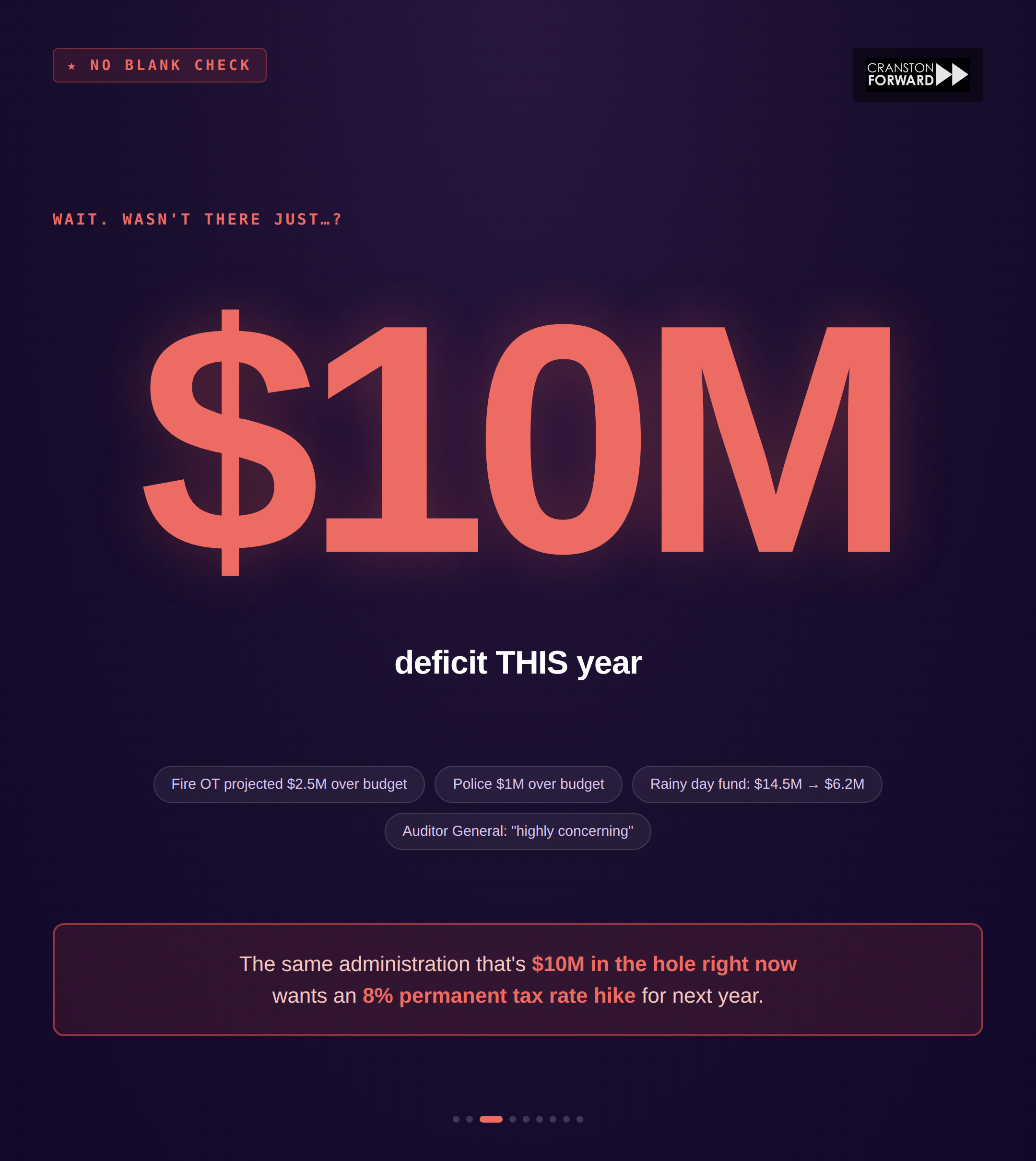
On May 7, Cranston Forward hosted a forum at the William Hall Library about Cranston’s budget crisis: an FY2025 deficit of $6.5M, a current (FY2026) deficit of $10.6M, and a fund reserve that will be drained by next month. This crisis was compounded by the administration’s failure to file budget reports with the state auditor for the entirety of FY2025, which could have led to much earlier corrective action. The Council for its part failed to conduct sufficient oversight.
HOW DID THIS HAPPEN?
We are in this crisis in large part because of incompetence, waste, and a lack of transparency.
Some of the deficit drivers identified at the 5/7 budget forum include:
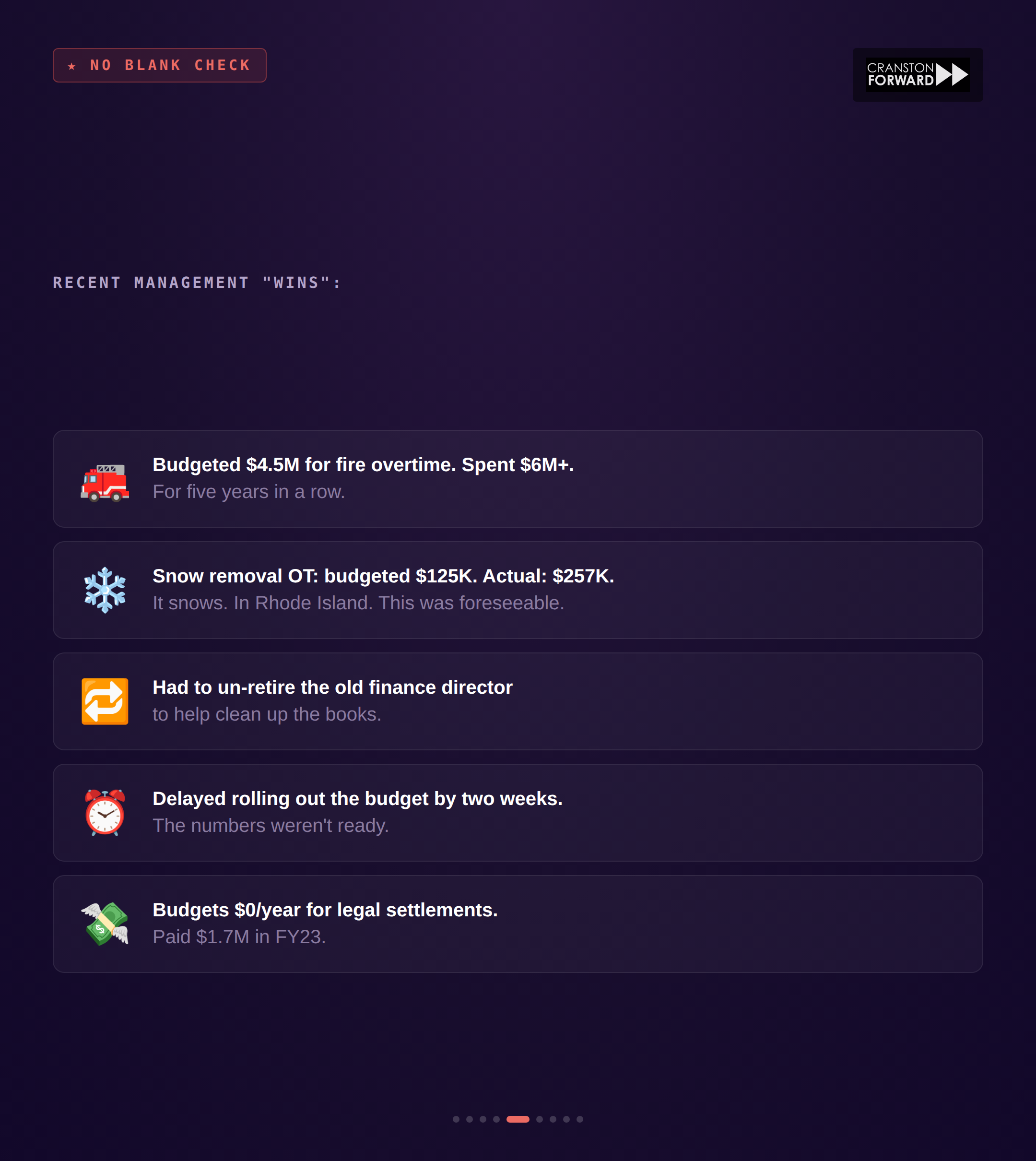
Excessive/unbudgeted fire and police overtime.
A $2M understatement of interest owed on debt.
Inclusion of interest revenue from already spent ARPA funds.
A pattern of wasteful, unnecessary spending and borrowing (e.g., $10M after grants for Knightsville rehabilitation; an estimated $90k for a full-time driver for the Mayor.)
Overreliance on high-interest borrowing for non-capital expenses.
Irresponsible avoidance of incremental tax increases to keep pace with inflation.
A lack of economic development planning and a competent grant-writing staff.
Recent news reports also hint at fraud and abuse: $50,000 (and rising) in legal bills to defend the city from a lawsuit alleging the Mayor’s misuse of city resources in a private dispute; and $7500 buried in a legal expense report for services by a political consultant–which the administration cannot explain.
WHAT NOW?
The Mayor delivered his first budget proposal two weeks late (on April 15), which sought to “fix” the problem with a 7.44% tax hike and cuts to Head Start and senior services but nothing to address the underlying structural issues or to replenish the rainy day fund. The City cannot raise taxes more than 4% without approval of the State legislature. With no support from any Cranston legislator, the Mayor’s bill to lift the cap was dead on arrival and the Council unanimously rejected his budget proposal.
On May 11, the Mayor released a new proposal with a 4% tax increase, which balances the budget by inexplicably increasing projected interest income by $1.5M, completely eliminating senior services and flat funding the schools (which, since school expenses continue to increase annually, amounts to a significant cut).
Cranston Forward has called for fully funding vital services for kids and seniors and for commonsense measures to reduce the structural deficit, including:
Adjust the city’s elderly and veteran tax exemptions to exclude high income earners.
Raise tax on solar plants (has not been increased since 2017).
Merge the Department of Economic Development, which has been completely ineffectual, into the Planning Department.
Cut unnecessary administrative positions including the Deputy Chief of Staff and the Mayor’s personal driver.
Defer East track & field facility.
Cut Axon Taser annual line.
Cut Ceremonial spending.
Cancel administrator raises.
Defer or cancel non-essential capital projects, including police department Tasers ($110K), lights for Fay Field ($450K), and scheduled road paving and improvements ($2M).
Transfer cash balance of $665,000 in ice rink account to the rainy day fund.
We also called on the City to fund any amount above the 4% state tax cap with a one-time assessment, to allow time for deeper structural reforms to be considered, such as:
Collectively bargaining changes to fire department staffing to reduce overtime;
Obtaining a forensic audit to uncover other potential fraud and abuse
Auditing the City’s excessive use of no-bid contracts.
Under the city charter, a new budget must be approved by the Council by May 15 or the Mayor’s proposal goes into effect. The Mayor’s delay in releasing proposals has deprived the Council and public of a full opportunity to weigh in on solutions. The Council has scheduled a special council meeting followed by a finance committee meeting to begin at 6:30 this Thursday (May 14) and a special council meeting starting at 6 pm on Friday to consider and vote on the proposal.
We urge concerned citizens to show up and speak up during public comments and to email or call the Mayor (780-3104), as well as their ward council member and the 3 city-wide councilors (contacts located here).
Participants at the May 7 Cranston Forward budget forum had many good questions and ideas about how to ensure better oversight, transparency and meaningful opportunities for public input into Cranston’s budget priorities. Cranston Forward invites people to share additional budget questions and ideas here.
Finally, residents who want better leadership for Cranston should consider a run for local office and/or volunteering to help someone else to run. Viable candidates will have an opportunity to win our endorsement and the campaign support of a grateful community.
No Blank Check for Mayor Ken Hopkins
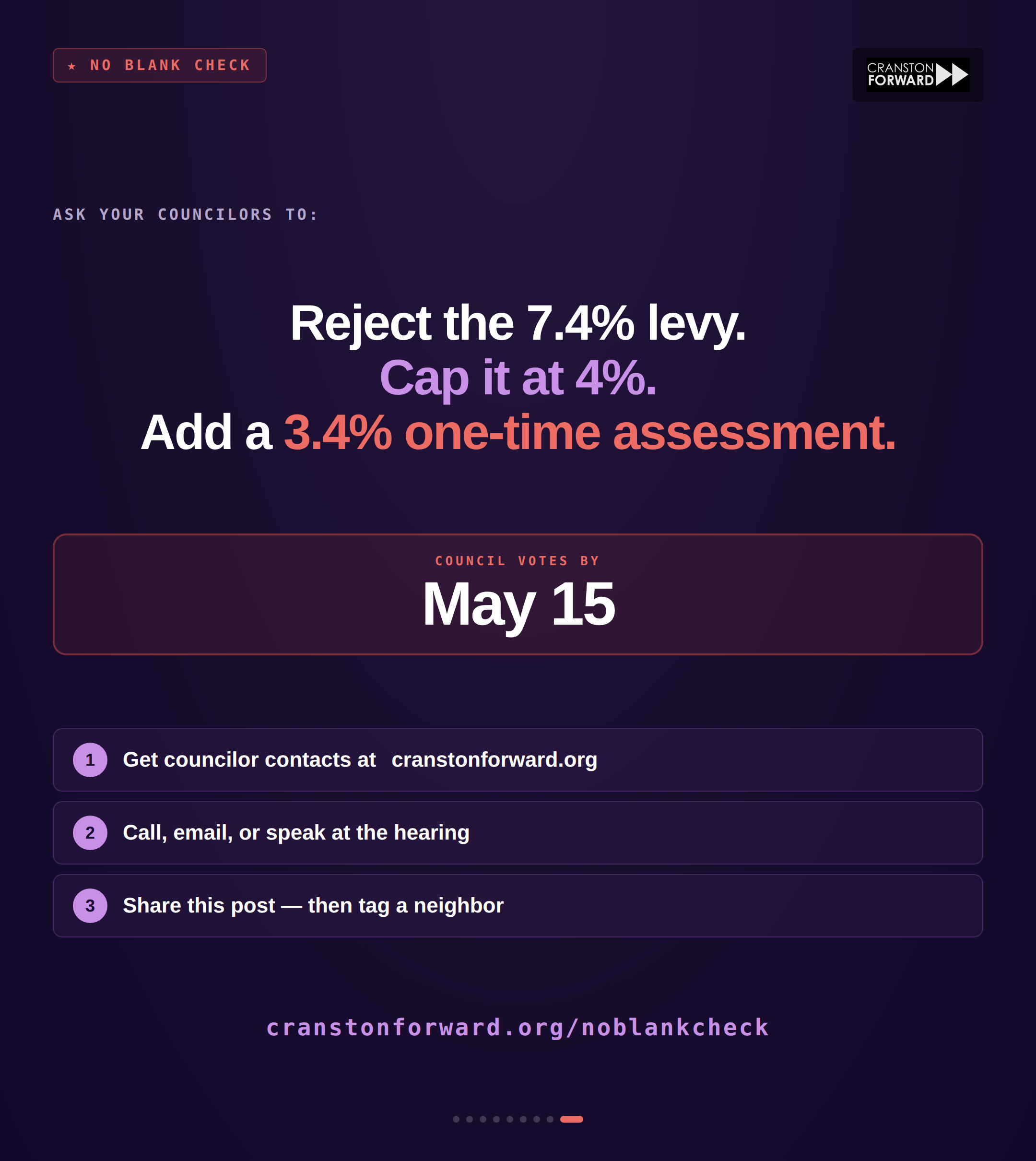
Cranston City Council votes by May 15 on Mayor Hopkins' FY27 budget. Tell them to cap the permanent property tax levy at 4% — and fund the rest with a one-time assessment.
What Mayor Hopkins Is Asking For
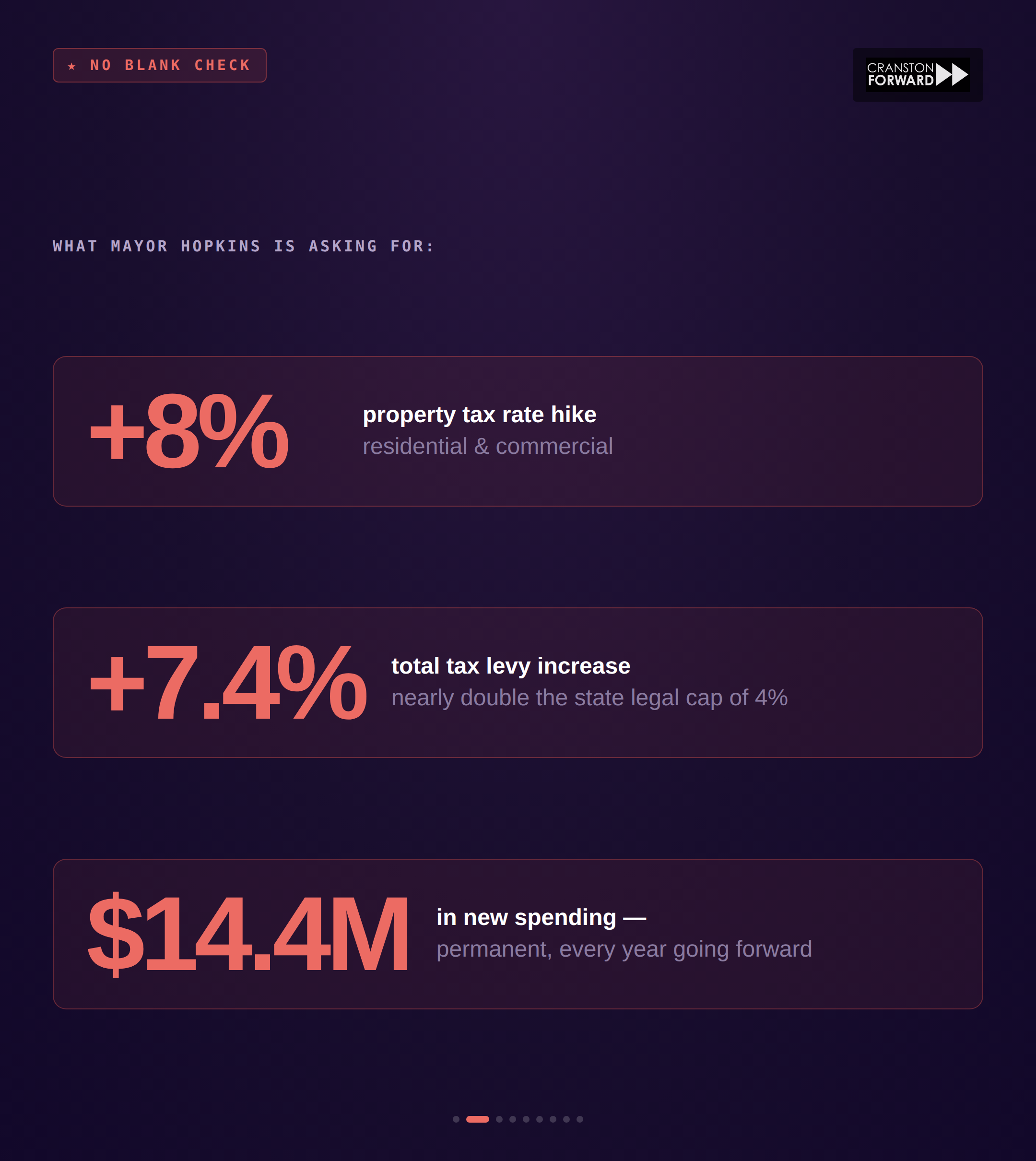
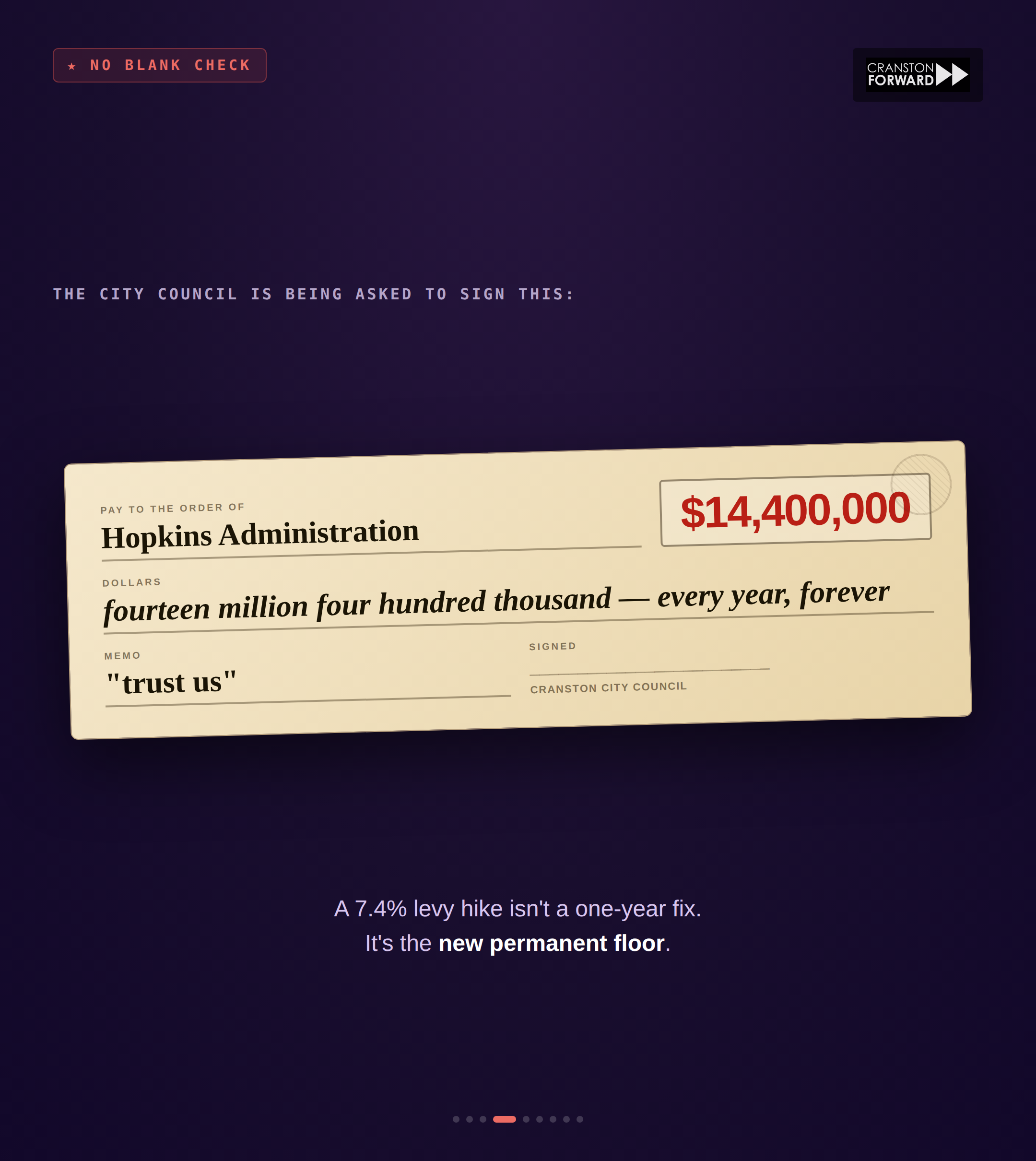
Mayor Ken Hopkins' proposed FY27 budget raises Cranston's total spending by $14.4 million — a 4.25% increase over FY26. He's funding it with:
An 8% property tax rate hike. Residential rates jump from $13.88 to $14.99 per $1,000 of assessed value. Commercial rates jump from $20.82 to $22.49. For a $400,000 home, that's an extra $444 every year — forever.
A 7.44% total tax levy increase. This is nearly double the 4% annual limit that Rhode Island state law sets for most cities and towns. Under RI General Law § 44-5-2, exceeding 4% requires a 4/5 supermajority vote of the full City Council, plus certification that Cranston is in an "emergency situation."
This is not a modest adjustment. This is the largest single-year tax rate increase Cranston has seen in recent memory, combined with a large new debt commitment.
Our Proposal to City Council
The Mayor is rushing through a budget that was delivered 2 weeks late, asking for
A permanent 7.44% increase to the tax levy, 3.4% more than the maximum allowable annual increase of 4%.
The Council should not be greenlighting a permanent 7.4% tax increase, without turning over every stone to cut the waste and unnecessary spending. For instance, the burden must be on the Mayor to explain why there are not less costly alternatives to nearly $11M/year in fire and police overtime.
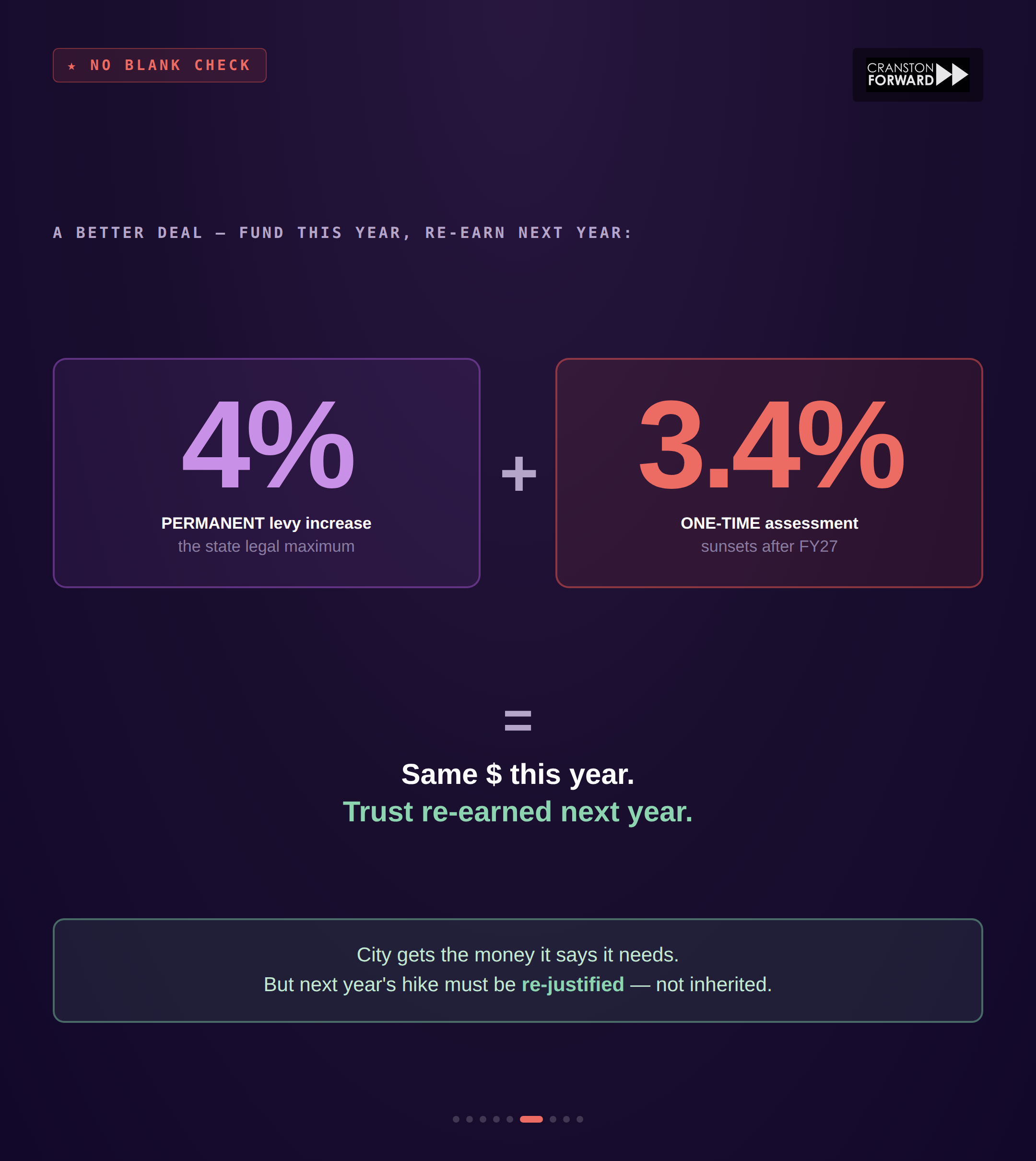
Since the Council may not have all the answers before the July 1 deadline for a new budget, the Council may have to pass a 4% increase, but any additional spending can be funded through a
ONE-TIME supplemental assessment that will sunset at the end of the fiscal year.
A one-time assessment is a well-established municipal tool that lets a city address an acute shortfall without handing the executive branch an unlimited future draw on taxpayer resources. It forces the administration to demonstrate improved fiscal discipline before coming back for another increase — This is the accountability Cranston needs.
Call Your Four City Councilors
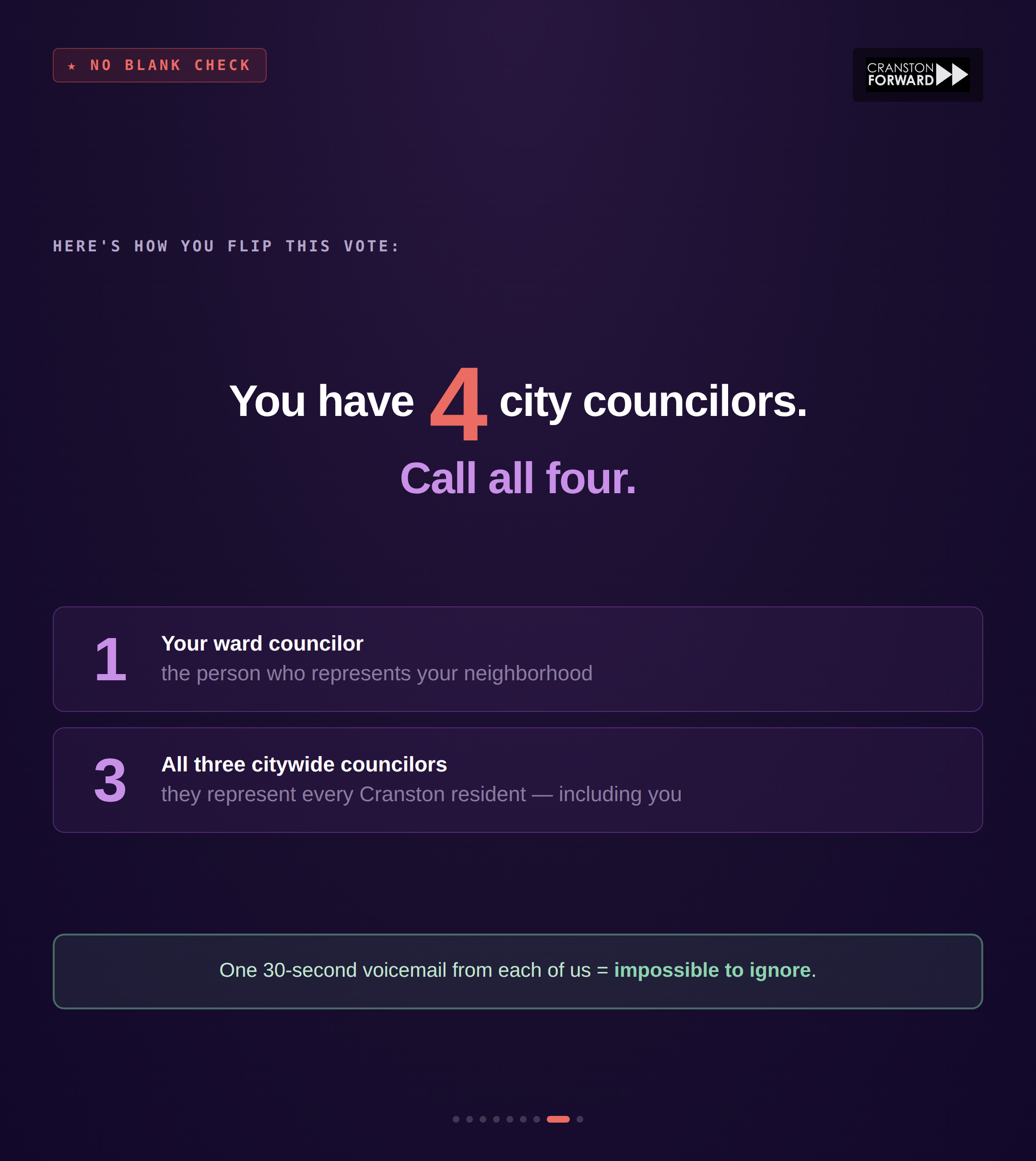
Every Cranston resident is represented by four city councilors: one ward councilor for your neighborhood and three citywide councilors who represent every resident.
Call all four. Email all four. Thirty seconds from each of us is impossible to ignore.
Citywide Councilors (call all three)
Every Cranston resident can contact these three — they represent the whole city.
Emilia Vaziri (D) — Citywide 401-536-1109 vaziri4cranston@gmail.com
Richard D. Campopiano (R) — Citywide 401-527-8382 rd.camp@yahoo.com
Christopher E. Buonanno (R) — Citywide 401-388-0884 councilmanbuonanno@gmail.com
Ward Councilors (call yours)
Your ward councilor depends on where you live. Not sure which ward you're in? Look it up at vote.ri.gov.
Ward 1 — Bridget R. Graziano (D) 401-487-4272 bridgetforcranston@gmail.com
Ward 2 — Kristen E. Haroian (D) 401-529-3344 kristenharoian@gmail.com
Ward 3 — Andy M. Andujar (D) 401-358-3300 voteandujar@gmail.com
Ward 4 — Frank J. Ritz, Jr. (R) 401-265-9941 frankritzforcranston@gmail.com
Ward 5 — Michael A. Traficante (R) 401-480-1813 mtraficante@nellmct.com
Ward 6 — Daniel Wall (D) — Council President 401-935-8935 danwall67@gmail.com
A 30-Second Script You Can Use
Feel free to rewrite in your own words — these are the beats that matter.
Hi, my name is ____ and I live at ____ in Cranston. I'm calling to ask Councilor ____ to vote NO on the FY27 budget as currently proposed.
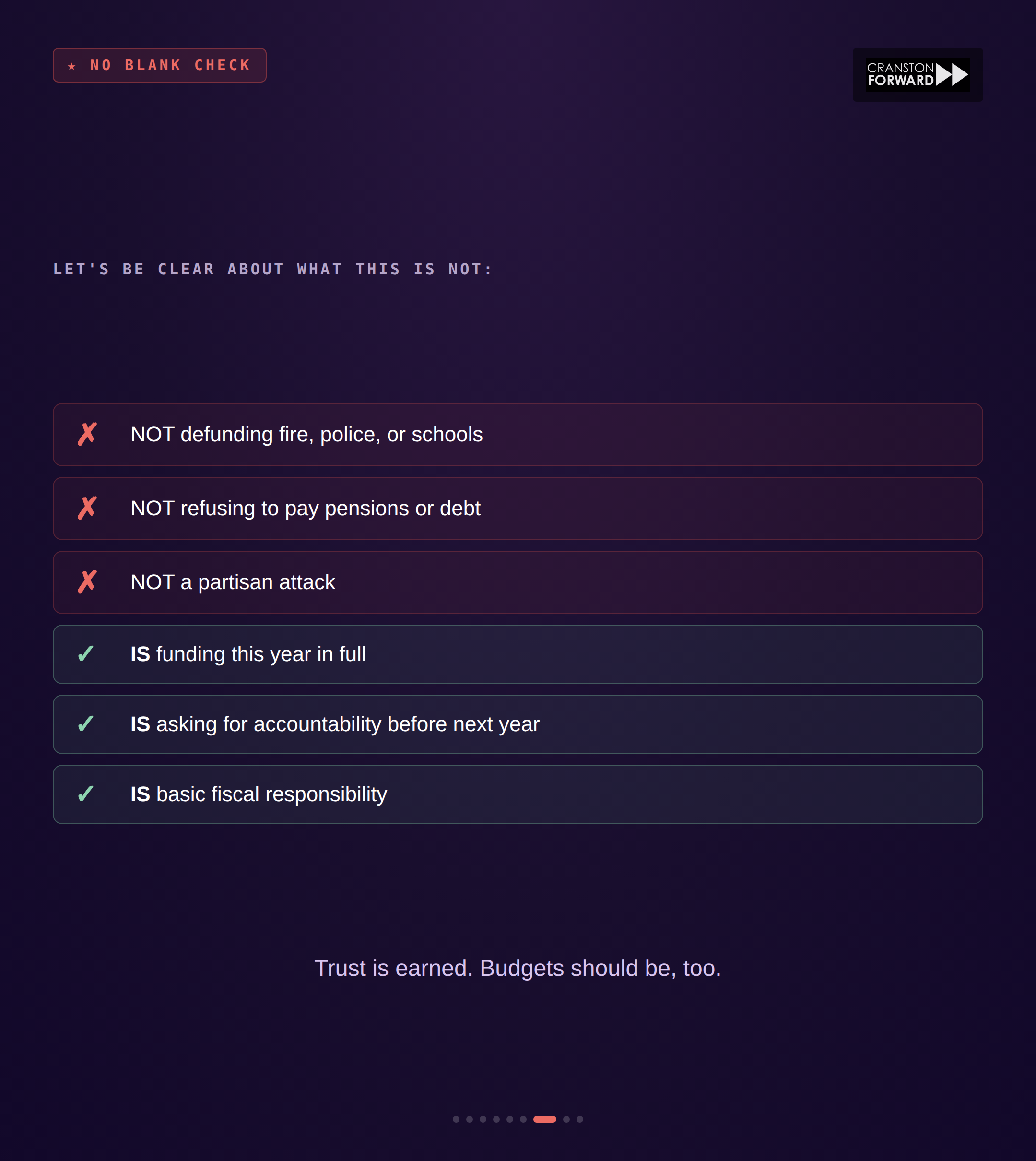
I'm not asking you to defund anything. I'm asking you to cap the permanent tax levy increase at the 4% state legal maximum, and cover the rest of this year's spending with a one-time supplemental assessment.
This administration is $10 million in the hole right now. Before we lock in $14.4 million in new permanent spending every year forever, the Mayor should have to earn that trust — not inherit it.
Thank you for representing Cranston. Please don't write a blank check.
Speak at the Budget Hearings
Council votes by May 15. Public testimony slots are available at the Finance Committee budget hearings held throughout late April and early May. You can testify in person at City Hall or by phone via the Council's conference line.
The full budget hearing schedule is posted at cranstonri.gov under "City Council" — look for "2026-2027 Budget Hearing Schedule."
Meetings are livestreamed on the Council's YouTube channel. You can raise a hand to speak by pressing *9 if you're on the phone, or using the "raise hand" feature if you're joining online.
Read Our Full FY27 Budget Analysis
We've published a line-item analysis of every major change in Mayor Hopkins' proposed FY27 budget — from the 66% spike in bond interest to the cuts to senior services, tree care, and Head Start, to the $2 million in capital bonding for a high school track that residents never voted on.
Frequently Asked Questions
Q: Is a one-time assessment legal under Rhode Island state law? A: Yes. RI General Law § 44-5-2 sets the 4% cap on permanent levy growth, but also contains emergency provisions and specific carve-outs. A supplemental assessment structured as one-time does not set a new baseline for future years — which is the entire point. If Council chooses to exceed the 4% cap permanently, it also requires a 4/5 supermajority and a formal "emergency situation" certification from the Auditor General.
Q: If we cap the levy at 4%, won't services get cut? A: Not if Council approves the one-time assessment for the remaining 3.4%. That's the whole design. The city receives the full FY27 dollars it needs. Nothing gets cut this year.
Q: Isn't this just partisan politics? A: No. This proposal would be the same whether the Mayor was a Republican, a Democrat, or an Independent. Basic fiscal discipline — don't hand the executive branch a blank check after they just announced a $10M deficit — is a civic principle, not a partisan one. Cranston Forward is nonpartisan.
Q: What about Cranston Public Schools? A: The school department asked for the full 4% levy maximum. Our proposal preserves every dollar the city has committed to schools in FY27 — the cuts would come out of administrative and political priorities on the city side, not out of classroom funding.
Q: What happens if Council just passes the Mayor's 7.4% as-is? A: That $14.4 million becomes the new permanent floor. Every future budget starts from that higher baseline. Future increases would be calculated on top of it. It's a decision that bind the next mayor, and the next Council, and every Cranston taxpayer — forever.